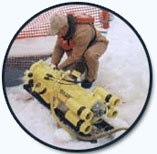
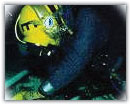
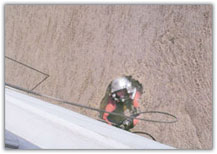
There are numerous direct benefits to choosing a qualified commercial diving contractor for the potable water system maintenance: You Don't Have to Drain Your Tank.
In short, Advanced Diving Services, Inc., can save you a lot of time, significant money and eliminate virtually all the hassles associated with "Traditional" tank draining methods.
When you account for all direct and indirect cost factors associated with conventional tank draining programs, the savings provided by ADS procedures are significant. No wasted water, no OSHA Confined Space concerns, no change in routine operation procedures, no requirement for high pressure pumps, squeegees, hoses and associated personnel, no lost storage capacity (i.e., fire suppression concerns) and finally, none of the hassle routinely involved with normal tank draining operation. Our customers tell us that when they consider all these issues, ADS consistently saves them a minimum of 30 % - 50 % in direct and indirect costs. That means you save thousands of dollars and substantial frustration every time you have us solve your storage system problems.
Virtually anything you need done on and in your tank, tower or clearwell. ADS provides a complete range of maintenance services including: detailed inspection, cleaning of accumulated bottom sediment, interior coating repair, valve, overflow and riser installation, modification or repair. We provide baffle installations and clearwell equipment and offer a full range of leak detection, repair services and mitigation as well, all while your system remains fully operational and in normal service.
All ADS operations exceed the strict disinfection standards of AWWA C652-92. Each piece of dedicated potable water dive equipment which enters your water system, including the totally encapsulated diver, is completely disinfected with a high concentration chlorine solution (200 ppm+) prior to entering your tank or clearwell. Compared to the old-fashioned methods of using ladders, scaffolding, rubber boats, boots, hoses, squeegees, brushes and the like; then attempting disinfection by spraying the interior of the tank - almost as an afterthought - today's disinfection procedures are a tremendous leap forward in both efficiency and effectiveness.
The key issues are the rate and quantity of sediment accumulation in your water system, source water and frequency of routine tank maintenance. AWWA Standard D101 - 53 (R1986) Section A - 1.1 states that "In any event, all water tanks should be thoroughly inspected at intervals of not more than five years." Nearly all our clients have us inspect their tanks every two to three years. NOTE: Even if you are chlorinating your system, a bottom sediment accumulation greater than 1/4 of an inch can prevent disinfection, or even identification, of any underlying bacteriological contaminates which may be present. It is also important to understand that in order to conduct the "thorough" inspection called for in D101-53, any accumulated bottom material must be removed in order to properly examine the floor structure and coating integrity.
ADS inspects thousands of steel tanks throughout the country. Based on this experience our clients routinely expect an average of 8-12 years of useful life for the interior coating systems. This is true, even in the northern part of the country with the most sever annual winter scour damage caused by floating ice caps - even to areas as diverse as the deep South with its high humidity and salty environment. The most important considerations for achieving this length of coating lifespan are; first, the competence of the coating applicator; second, the integrity of the application; and finally, the quality of the coating itself. Each year hundreds of utilities use ADS to provide detailed underwater coating inspections, while their newly applied coating application problems are identified within that warranty period. Coating systems left unchecked or inspected with the "look through the hatch" method, will typically have a reduced life-span. Again, as will all ADS services, these warranty acceptance inspections are performed with the tanks in normal service.
To sum up: over the years of inspection and repair of water storage tanks, we have found that a quality interior coating system applied by a competent painting contractor should easily carry through a minimum 10 year life. This assumes that there is regular routine inspection and repair of areas of failed coating as well as the installation of a cathodic protection system. (Given the nominal installation and operating cost associated with a properly installed cathodic protection system, it is beyond doubt the most economical insurance you can buy.)
In our experience, long-term paint maintenance contracts are swiftly becoming a thing of the past. The reason given by our clients is that today's high quality coating systems and improved application techniques makes frequent blasting and coating uncalled for. Keys to achieving maximum coating system life are, most importantly, a precise inspection of the newly applied coating, undertaken during the contractor's warranty period by a disinterested third party, along regular routine inspection of any localized areas of coating failure. The fact is, long-term maintenance contracts are almost always a waste of you r hard working budget dollars.
There are three significant criteria in selecting a diving contractor to service your water system; the contractors' experience, technical experience, and the equipment they use. Contractor's experience - Look for a commercial diving contractor whose experience in potable water operations is consistent. This will ensure that you are dealing with someone who understands - and can meet - the unique requirements of this highly regulated and technically demanding specialty. Ask references and check them. Technical Expertise - What are their capabilities? What kind of work has the contractor done in the past?
Qualified Contractor Minimum Equipment Requirements - Under the newly revised AWWA Standards for Potable Water Diving Operation, the following equipment is required:
Insist upon real-time live color video with voice recording to the surface during all procedures. This allows you to see what the dive technician sees and talk directly to the diver about specific inspection and repair activities. Beware of the diving contractors who use a hand-held video camera with an "after the fact" voice dubbing as a method of documentation. Specify live, surface monitored video and voice. This ensures that you select what you see, not what someone else chooses to show you.
Besides the regulatory and liability issues, there are tremendous differences between SCUBA divers and commercial divers. SCUBA divers - those certified by NAUI, PADI and YMCA - have received , at best, a total of 20 to 30 hours of training as a "sport diver." Compare this with a Certified Commercial Diver who receives a minimum of 6 month of full-time training in all aspects of commercial diving: non-destructive testing, hyperbaric medicine, rigging, underwater construction, decompression, inspection, commercial diving safety standards and federal diving regulations. Further, the sport SCUBA diving agencies themselves take the following positions regarding the qualifications of their divers:
In 1991 a California water utility hired certified SCUBA divers to inspect their potable water storage tanks. In 1997 a Texas water utility had one of their employees, a certified SCUBA diver, enter one of their water tanks for a "routine" underwater inspection. Divers died in both instances. The reasons were the same; improper equipment and inadequate training. Using a properly equipped and trained certified commercial dive team would have prevented both tragedies.
In short: sport diver training is geared to diving with SCUBA gear as a breathing source for personal enjoyment; such training falls far short of providing the knowledge, experience and expertise required to meet the conditions of commercial diving. This regulatory requirement is clearly stated in ANSI/ADC 01 - 1993 as well as OSHA 1910.401(T).
IMPORTANT NOTICE: In the event that you allow sport SCUBA divers to enter your water system, whether or not they are your employees (or or if you hire an outside SCUBA "contractor"), you are liable for any injuries. Use properly trained, certified and insured commercial divers and this potential liability is eliminated.